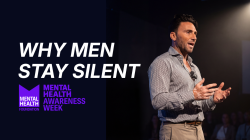
Men's mental health at work | Mental Health Awareness Week 2026
Three quarters of all suicides in the UK are men. Most of them never said a word.
Caridon marked Mental Health Awareness Week 2026 with a Big Brunch, and the conversation went considerably further than most workplaces allow.
Inside Caridon is publishing it in full.
CEO Mario Carrozzo talks about the few weeks of severe depression that followed losing everything financially, and about the colleague who came into his office to ask if he wanted a cup of tea and took his life that same night. Tarun Hari Das (Trevor), sound healer and mental health advocate, describes his own suicidal crisis, being ripped off in the music industry, and what took him to the Himalayas. HR director Anthony Badresingh sets out what Caridon offers its people.
The session covers why 84% of employees faced mental health challenges last year and what workplaces still get wrong. The four pillars of self value that determine whether someone holds together or collapses. Habits for the working day that cost nothing and need nobody's sign-off. Why men in particular stay silent, and what that silence costs.
If you or someone you know is struggling, contact Samaritans on 116 123, free, any time, or visit mind.org.uk.
Mental Health Awareness Week 2026 is about action. For yourself, for someone else, for all of us.
Listen on Spotify: https://open.spotify.com/episode/2wfrdm487ektbaLoP...
Listen on Apple Podcast: https://podcasts.apple.com/us/podcast/inside-carid...
Watch on Youtube:
Mario Carrozzo:
So firstly, Trevor is a good friend of mine as well as being a producer. He's working closely with my daughter Sienna at the moment. He's got a background in health and wellbeing, and because he was in the area, I thought I'd bring him in. Because obviously that's a big part of mental health. So he's going to say a few words as well.
Obviously I'm no expert in mental health. I can only talk about my own experiences. And today is Mental Health Awareness Week, and the action, apparently, I've been told, is action for yourself, for someone else, and for all of us. That is the action, I guess.
I'm sure we all know someone that's affected by mental health. I always relate things to my own experiences. Without going into the whole story, I've been through quite a few ups and downs in life, losing everything. You go through challenging times, so for me it affected me.
I went through a little patch of very, very bad depression for the space of only a few weeks, but it seemed like a lifetime. And that was financial. It affected me financially. Obviously mental health affects you in different ways: financial, your health, family, friends. It can affect you in different ways, and everyone deals with it differently.
With depression, from my own experience, I would say you have to help yourself. I remember when I was going through it, and I had my mum coming round, putting her arm around my shoulder, don't worry, everything's going to be alright. You know what, I had like £20 million quid of debt. It weren't going to be alright, in my head.
But you have people close to you that want to put their arm around you and try to help you. What I realised quickly was that although it felt good at the time, because you want that comfort and people around you, it's actually not helping you, because you're getting comforted by the support. But you have to come to the realisation that the only one that's going to get you out of it is yourself.
So for me, as much as it was nice to have the support, there was a point when I thought, I have to get out of it. And slowly, slowly, thanks to the support of my family and friends, I got out of it.
I was reading some stats the other day, and I didn't realise until I read them that three quarters of suicides are by men. Crazy. It's unbelievable when I read that. And talking about 84% of employees facing mental health challenges last year.
And I think there is a stigma around men talking about mental health, because we want to be seen as the man, and all the rest of it. A bit egotistic sometimes, I suppose. But it's a reality, and people are scared to talk about it. And I think it's sad. We should talk about it, because we all go through the same things.
And I know it's quite strange, because sometimes you could have someone in the workforce who could be the joker. But they're hiding it. From the outside it looks like everything's good, but inside they're going through their own things, I guess.
And I know Anthony will touch on this a bit more, about work and what we can do. Basic little things. So thinking about just leaving your office to have lunch. Some of us are workaholics. But I think it's so important to get out for lunch, a bit of fresh air, a bit of the occasional sun that we get here anyway. That fresh air is so, so important, firstly.
And the other thing, which maybe the mean bosses would probably say the opposite, but I'm on the other side of it: emails after work, weekends. Don't get me wrong, there are emergencies, you have to deal with stuff, right? But I think it's fair to say when you get an email on a Sunday night or a Friday night, it's a pain, right? And you get anxiety. We all do. I don't even look at it, if I'm being honest. So I think limit the emails unless it's urgent.
Although, like I said, if it is urgent you're going to do it, because that creates that bad feeling when you've had a break. The worst thing is you on a Sunday night thinking, I'm stressing going into work. So try and limit that, and try and stay in contact with your colleagues.
You don't always see it. And I've personally lost two or three friends to suicide.
One guy, a few years ago, used to work here. I'd known him for like 10, 15 years. I might have told you the story, but he had a lot of problems, and he had mental health issues. And I can remember it like it was yesterday. I was sitting in my office upstairs and he came in. He goes, mate, do you want a cup of tea? I don't drink tea. And I said, no, no, I'm alright, thank you. But I looked at him, and his face looked a bit strange. I don't know what happened. He just looked unusual. So I carried on with my busy life, and he just left, strangely. That was it, and I went to bed.
And that night I got a phone call from my brother that he'd taken his life the same night. And I felt guilty, because I didn't give him the time. Maybe he just wanted to reach out, and I was so busy. Although he was only asking me if I wanted a drink, he probably wanted a bit of time from me, and I didn't know how deep things were.
And obviously we lost Paul, who used to be MD, lost to mental health. He suffered with it for many, many, many years. So it can happen to anyone. If you've got any addiction, drugs, gambling, whatever it may be. But trying to communicate with people that are close to us is all I can say, because it can happen to anyone, no matter what position you're in. Rich, poor. It happens to anyone.
That's all I've really got to say. Sport is a big part for me, and I'm not saying this for everybody. When I went through what I went through, if I didn't train, I would have been dead. That's the truth, because that was my outlet.
Everyone's got a different outlet. It might be a hobby, it might be cooking. For me it was hitting the gym. So I think sport is a really, really big part, and if we can do more in the business to encourage any sort of activity, whether it's mental or physical, that's going to help you, then let us know. Don't be scared to reach out and see if there's anything else we can do.
Tarun Hari Das (Trevor):
Hello, everyone. So I'm going to stay seated. Standing makes me feel nervous. [Sitting] actually makes me feel a bit grounded. So my story is quite deep. I'm going to see if I can blast through and drop some gems at the same time.
I was actually a suicidal case myself, just to put it out there. And what I did to reverse that: I ended up in the Himalayas, just to plug out of a system where I thought I couldn't get any answers, and what drove me to suicide.
At the time I was doing quite well in the music business. Then I was ripped off from big projects, like doing Peter Andre, Mysterious Girl. The missus at the time, [she ran off with the kids into another relationship], and then I was left with all the financial strain of trying to balance the house and this and that.
So the key thing, going through the journey after going to the Himalayas: I ended up going to Regent's College to get a degree in psychology and so forth. So I started to travel backwards and forwards and study Vedanta, to understand consciousness as a whole.
And when it comes to mental health, the key thing is self value. Self value is a big major part of keeping yourself together. And we normally sell ourselves this concept of trying to create self value through the perception of others. What do you think of me? Do you like me? Blah, blah, blah. And we lose a pivotal understanding of what we truly are.
I don't want to get too religious or too fanatical with it in one sense. But this has all been scientifically mapped out as well. So I've gone to the depth of studying the science of it, and neurology and so forth. And I run retreats now in Portugal. I do about five retreats a year. I also got into sound healing, got special Tibetan bowls made. Very powerful, to see how sound resonates and affects the body, the mind. The metaphysical connection between the two is a very powerful thing.
And simple little things, like your ability to laugh, shows your true value. If you don't have the ability to laugh, you don't like yourself. This is a deep thing. Promoting laughter, connectivity and growth, especially in your environment.
So I went as far as studying the chakras and so forth. A lot of people would say that's woo woo science, but there is a lot of applicable, practical sense to it.
So just to give you a little understanding of how the base root chakra works. It has four corners, four pillars. The first pillar is: how much do you love yourself? And we get lost in understanding what this word love means. So breaking it down as an acronym, I've broken it down to life's optimum vibratory energy. Take all the fanatical essence out of it. How much can you enjoy life's optimum vibratory energy? So how much can you enjoy that for yourself? That's the first quadrant.
The next quadrant is: how safe do you feel in your environment? The next one is: how safe do you feel communicating with others in this environment? And the final one is: how safe do you feel growing in that environment? If any of these four quadrants are shaky, mental health, physical health, anything called health is going to collapse.
So as a metaphysical or mental note, if you can keep a resonance about this for yourself, to keep a check. Are you laughing enough? Are you enjoying yourself enough? Are you treating yourself enough? Are you waiting for somebody to give you the opportunity to treat yourself? These things are key. You're allowed to treat yourself, in your environment.
Also make sure that your environment stimulates you. Keeping it clean, keeping it fresh, fresh air and stuff like that, is very important. Communicating with others, and encouraging others talking. Unifying these things is really key.
And also, if you're talking to other people about what could be their problems, if you examine these four quadrants you might find a way to create a thread to help them out of the situation that they're in, and help them build a steady platform towards higher states of being. Because on that lower vibration, if you don't have those things locked in as a way of being, there's no way you can resonate from the heart. And most people are stuck on a lower level, just trying to sort these four quadrants out, getting confused, thinking that's the whole of life. That's just the basics.
So I don't want to go on too long. But simple things, like checking in in the morning when you wake up. The first thing that you tell yourself on the pillow is very important. Encourage yourself to love yourself with the first breath that you take.
Don't wake up and start thinking about problems and this and that, and what am I going to do, oh, it's late, what am I going to feed the kids, blah, blah, blah. Encourage yourself to love yourself with your first breath. That's really key to start triggering a pattern of wellbeing throughout the whole day.
You have to be grounded within you. You have to value you first. And once that's written on your face, everybody else will value you. If you look like, do you value me? That sign of desperation is written all over.
Mario Carrozzo:
You mentioned before, he's obviously been in the industry and he's got a great story too. Maybe just a snippet of your journey, starting off and being in the industry. Obviously you get to see a lot.
Tarun Hari Das (Trevor):
Yes, there's a lot. That's why I'm saying this. I started in music very young, coming up literally through the church with my mum and dad. They were pastors in the church. And also jazz and classically trained. I was a bit of a prodigy. I was playing grand piano for the Queen Mother at the age of 13. So I was this prodigy that they were moving around the place. I was travelling early and got into productions pretty early. They used to fly me around the world.
The falsities of what the industry was showing me at the time, in terms of what to value as being you, was all subject to status. You buy into this idea of my status is who I am. And the minute that status gets pulled from underneath your feet, the anxiety comes. Oh my gosh, I'm no longer this, I'm no longer that. You're greater than your status, and you need to tap into that, understand that all the labels the world can give you are insignificant to what you truly are.
Right, leave it there. Thank you.
Anthony Badresingh:
Thank you, Trevor. Thank you, Mario. So, basically, I'm just going to give you a brief spell about what Caridon can offer with regards to support going forward, with regards to mental health and everything else.
So first of all, we have mental health first aiders who were trained voluntarily. They're your colleagues, so they're within the business. I'm not going to name their names now, but if you do want to have a discussion with any of them, come and see HR and I'll point you in their direction.
Secondly, through the Employee Assistance Programme, which is via Health Shield, we have a counselling service where you can get eight sessions, for free, obviously. And obviously that's going to be by qualified professionals.
Also within Health Shield again, because obviously exercise is good for your mental health, there are gym discounts that you can get via Health Shield.
And also, to finish off on Health Shield, there are self care tips. So I encourage you all to actually go and look at Health Shield. I'm one of those who didn't actually look at it properly until I thought, okay, let's just see what we do offer our employees. I might be able to use it myself. And I was actually quite surprised, especially with the self care tips. They're very good. It tells you how to plan your day, your working day, what to do to alleviate stress, and also just to have a better environment around yourself.
And also just to finish off on Eloomi. There is a short mental health course that will just give you more awareness and depth of knowledge, so you can become aware of it. If you're identifying somebody else, or just to be supportive to somebody else, or just for your own wellbeing, I suggest you have a look at that as well. That's it.
And also, like what Mario touched on: just take a step away from your desk. Get a group of you, go for a walk around the block, or just do something to get out. Because 20 minutes is supposed to be at a desk, 25 minutes screen time, and then you're supposed to take a break. I don't really want to advocate that, but legally, that's what they say. I haven't told you that, so scrub that.
And also the football as well, like these boys do. I don't know if we should open it up to the women as well. Just go out there, play football. Exercise is good for the brain. Like Mario said, it's good. I go jogging most mornings when I can.
The recording continues with an open team discussion about workplace wellbeing, which is not included in this transcript.

Croydon Property & Housing Summit 2026 keynote | Mario Carrozzo 7 August 2026 - Read more

Men's mental health at work | Mental Health Awareness Week 2026 18 May 2026 - Read more

eXp Realty UK explained | Inside Caridon Podcast | Caridon Group 23 March 2026 - Read more
.png)
UK Property Investment 2026: Budget Analysis, AI in Real Estate & Dubai Opportunities 22 December 2025 - Read more
Men's mental health at work | Mental Health Awareness Week 2026
Three quarters of all suicides in the UK are men. Most of them never said a word.
Caridon marked Mental Health Awareness Week 2026 with a Big Brunch, and the conversation went considerably further than most workplaces allow.
Inside Caridon is publishing it in full.
CEO Mario Carrozzo talks about the few weeks of severe depression that followed losing everything financially, and about the colleague who came into his office to ask if he wanted a cup of tea and took his life that same night. Tarun Hari Das (Trevor), sound healer and mental health advocate, describes his own suicidal crisis, being ripped off in the music industry, and what took him to the Himalayas. HR director Anthony Badresingh sets out what Caridon offers its people.
The session covers why 84% of employees faced mental health challenges last year and what workplaces still get wrong. The four pillars of self value that determine whether someone holds together or collapses. Habits for the working day that cost nothing and need nobody's sign-off. Why men in particular stay silent, and what that silence costs.
If you or someone you know is struggling, contact Samaritans on 116 123, free, any time, or visit mind.org.uk.
Mental Health Awareness Week 2026 is about action. For yourself, for someone else, for all of us.
Listen on Spotify: https://open.spotify.com/episode/2wfrdm487ektbaLoP...
Listen on Apple Podcast: https://podcasts.apple.com/us/podcast/inside-carid...
Watch on Youtube:
Mario Carrozzo:
So firstly, Trevor is a good friend of mine as well as being a producer. He's working closely with my daughter Sienna at the moment. He's got a background in health and wellbeing, and because he was in the area, I thought I'd bring him in. Because obviously that's a big part of mental health. So he's going to say a few words as well.
Obviously I'm no expert in mental health. I can only talk about my own experiences. And today is Mental Health Awareness Week, and the action, apparently, I've been told, is action for yourself, for someone else, and for all of us. That is the action, I guess.
I'm sure we all know someone that's affected by mental health. I always relate things to my own experiences. Without going into the whole story, I've been through quite a few ups and downs in life, losing everything. You go through challenging times, so for me it affected me.
I went through a little patch of very, very bad depression for the space of only a few weeks, but it seemed like a lifetime. And that was financial. It affected me financially. Obviously mental health affects you in different ways: financial, your health, family, friends. It can affect you in different ways, and everyone deals with it differently.
With depression, from my own experience, I would say you have to help yourself. I remember when I was going through it, and I had my mum coming round, putting her arm around my shoulder, don't worry, everything's going to be alright. You know what, I had like £20 million quid of debt. It weren't going to be alright, in my head.
But you have people close to you that want to put their arm around you and try to help you. What I realised quickly was that although it felt good at the time, because you want that comfort and people around you, it's actually not helping you, because you're getting comforted by the support. But you have to come to the realisation that the only one that's going to get you out of it is yourself.
So for me, as much as it was nice to have the support, there was a point when I thought, I have to get out of it. And slowly, slowly, thanks to the support of my family and friends, I got out of it.
I was reading some stats the other day, and I didn't realise until I read them that three quarters of suicides are by men. Crazy. It's unbelievable when I read that. And talking about 84% of employees facing mental health challenges last year.
And I think there is a stigma around men talking about mental health, because we want to be seen as the man, and all the rest of it. A bit egotistic sometimes, I suppose. But it's a reality, and people are scared to talk about it. And I think it's sad. We should talk about it, because we all go through the same things.
And I know it's quite strange, because sometimes you could have someone in the workforce who could be the joker. But they're hiding it. From the outside it looks like everything's good, but inside they're going through their own things, I guess.
And I know Anthony will touch on this a bit more, about work and what we can do. Basic little things. So thinking about just leaving your office to have lunch. Some of us are workaholics. But I think it's so important to get out for lunch, a bit of fresh air, a bit of the occasional sun that we get here anyway. That fresh air is so, so important, firstly.
And the other thing, which maybe the mean bosses would probably say the opposite, but I'm on the other side of it: emails after work, weekends. Don't get me wrong, there are emergencies, you have to deal with stuff, right? But I think it's fair to say when you get an email on a Sunday night or a Friday night, it's a pain, right? And you get anxiety. We all do. I don't even look at it, if I'm being honest. So I think limit the emails unless it's urgent.
Although, like I said, if it is urgent you're going to do it, because that creates that bad feeling when you've had a break. The worst thing is you on a Sunday night thinking, I'm stressing going into work. So try and limit that, and try and stay in contact with your colleagues.
You don't always see it. And I've personally lost two or three friends to suicide.
One guy, a few years ago, used to work here. I'd known him for like 10, 15 years. I might have told you the story, but he had a lot of problems, and he had mental health issues. And I can remember it like it was yesterday. I was sitting in my office upstairs and he came in. He goes, mate, do you want a cup of tea? I don't drink tea. And I said, no, no, I'm alright, thank you. But I looked at him, and his face looked a bit strange. I don't know what happened. He just looked unusual. So I carried on with my busy life, and he just left, strangely. That was it, and I went to bed.
And that night I got a phone call from my brother that he'd taken his life the same night. And I felt guilty, because I didn't give him the time. Maybe he just wanted to reach out, and I was so busy. Although he was only asking me if I wanted a drink, he probably wanted a bit of time from me, and I didn't know how deep things were.
And obviously we lost Paul, who used to be MD, lost to mental health. He suffered with it for many, many, many years. So it can happen to anyone. If you've got any addiction, drugs, gambling, whatever it may be. But trying to communicate with people that are close to us is all I can say, because it can happen to anyone, no matter what position you're in. Rich, poor. It happens to anyone.
That's all I've really got to say. Sport is a big part for me, and I'm not saying this for everybody. When I went through what I went through, if I didn't train, I would have been dead. That's the truth, because that was my outlet.
Everyone's got a different outlet. It might be a hobby, it might be cooking. For me it was hitting the gym. So I think sport is a really, really big part, and if we can do more in the business to encourage any sort of activity, whether it's mental or physical, that's going to help you, then let us know. Don't be scared to reach out and see if there's anything else we can do.
Tarun Hari Das (Trevor):
Hello, everyone. So I'm going to stay seated. Standing makes me feel nervous. [Sitting] actually makes me feel a bit grounded. So my story is quite deep. I'm going to see if I can blast through and drop some gems at the same time.
I was actually a suicidal case myself, just to put it out there. And what I did to reverse that: I ended up in the Himalayas, just to plug out of a system where I thought I couldn't get any answers, and what drove me to suicide.
At the time I was doing quite well in the music business. Then I was ripped off from big projects, like doing Peter Andre, Mysterious Girl. The missus at the time, [she ran off with the kids into another relationship], and then I was left with all the financial strain of trying to balance the house and this and that.
So the key thing, going through the journey after going to the Himalayas: I ended up going to Regent's College to get a degree in psychology and so forth. So I started to travel backwards and forwards and study Vedanta, to understand consciousness as a whole.
And when it comes to mental health, the key thing is self value. Self value is a big major part of keeping yourself together. And we normally sell ourselves this concept of trying to create self value through the perception of others. What do you think of me? Do you like me? Blah, blah, blah. And we lose a pivotal understanding of what we truly are.
I don't want to get too religious or too fanatical with it in one sense. But this has all been scientifically mapped out as well. So I've gone to the depth of studying the science of it, and neurology and so forth. And I run retreats now in Portugal. I do about five retreats a year. I also got into sound healing, got special Tibetan bowls made. Very powerful, to see how sound resonates and affects the body, the mind. The metaphysical connection between the two is a very powerful thing.
And simple little things, like your ability to laugh, shows your true value. If you don't have the ability to laugh, you don't like yourself. This is a deep thing. Promoting laughter, connectivity and growth, especially in your environment.
So I went as far as studying the chakras and so forth. A lot of people would say that's woo woo science, but there is a lot of applicable, practical sense to it.
So just to give you a little understanding of how the base root chakra works. It has four corners, four pillars. The first pillar is: how much do you love yourself? And we get lost in understanding what this word love means. So breaking it down as an acronym, I've broken it down to life's optimum vibratory energy. Take all the fanatical essence out of it. How much can you enjoy life's optimum vibratory energy? So how much can you enjoy that for yourself? That's the first quadrant.
The next quadrant is: how safe do you feel in your environment? The next one is: how safe do you feel communicating with others in this environment? And the final one is: how safe do you feel growing in that environment? If any of these four quadrants are shaky, mental health, physical health, anything called health is going to collapse.
So as a metaphysical or mental note, if you can keep a resonance about this for yourself, to keep a check. Are you laughing enough? Are you enjoying yourself enough? Are you treating yourself enough? Are you waiting for somebody to give you the opportunity to treat yourself? These things are key. You're allowed to treat yourself, in your environment.
Also make sure that your environment stimulates you. Keeping it clean, keeping it fresh, fresh air and stuff like that, is very important. Communicating with others, and encouraging others talking. Unifying these things is really key.
And also, if you're talking to other people about what could be their problems, if you examine these four quadrants you might find a way to create a thread to help them out of the situation that they're in, and help them build a steady platform towards higher states of being. Because on that lower vibration, if you don't have those things locked in as a way of being, there's no way you can resonate from the heart. And most people are stuck on a lower level, just trying to sort these four quadrants out, getting confused, thinking that's the whole of life. That's just the basics.
So I don't want to go on too long. But simple things, like checking in in the morning when you wake up. The first thing that you tell yourself on the pillow is very important. Encourage yourself to love yourself with the first breath that you take.
Don't wake up and start thinking about problems and this and that, and what am I going to do, oh, it's late, what am I going to feed the kids, blah, blah, blah. Encourage yourself to love yourself with your first breath. That's really key to start triggering a pattern of wellbeing throughout the whole day.
You have to be grounded within you. You have to value you first. And once that's written on your face, everybody else will value you. If you look like, do you value me? That sign of desperation is written all over.
Mario Carrozzo:
You mentioned before, he's obviously been in the industry and he's got a great story too. Maybe just a snippet of your journey, starting off and being in the industry. Obviously you get to see a lot.
Tarun Hari Das (Trevor):
Yes, there's a lot. That's why I'm saying this. I started in music very young, coming up literally through the church with my mum and dad. They were pastors in the church. And also jazz and classically trained. I was a bit of a prodigy. I was playing grand piano for the Queen Mother at the age of 13. So I was this prodigy that they were moving around the place. I was travelling early and got into productions pretty early. They used to fly me around the world.
The falsities of what the industry was showing me at the time, in terms of what to value as being you, was all subject to status. You buy into this idea of my status is who I am. And the minute that status gets pulled from underneath your feet, the anxiety comes. Oh my gosh, I'm no longer this, I'm no longer that. You're greater than your status, and you need to tap into that, understand that all the labels the world can give you are insignificant to what you truly are.
Right, leave it there. Thank you.
Anthony Badresingh:
Thank you, Trevor. Thank you, Mario. So, basically, I'm just going to give you a brief spell about what Caridon can offer with regards to support going forward, with regards to mental health and everything else.
So first of all, we have mental health first aiders who were trained voluntarily. They're your colleagues, so they're within the business. I'm not going to name their names now, but if you do want to have a discussion with any of them, come and see HR and I'll point you in their direction.
Secondly, through the Employee Assistance Programme, which is via Health Shield, we have a counselling service where you can get eight sessions, for free, obviously. And obviously that's going to be by qualified professionals.
Also within Health Shield again, because obviously exercise is good for your mental health, there are gym discounts that you can get via Health Shield.
And also, to finish off on Health Shield, there are self care tips. So I encourage you all to actually go and look at Health Shield. I'm one of those who didn't actually look at it properly until I thought, okay, let's just see what we do offer our employees. I might be able to use it myself. And I was actually quite surprised, especially with the self care tips. They're very good. It tells you how to plan your day, your working day, what to do to alleviate stress, and also just to have a better environment around yourself.
And also just to finish off on Eloomi. There is a short mental health course that will just give you more awareness and depth of knowledge, so you can become aware of it. If you're identifying somebody else, or just to be supportive to somebody else, or just for your own wellbeing, I suggest you have a look at that as well. That's it.
And also, like what Mario touched on: just take a step away from your desk. Get a group of you, go for a walk around the block, or just do something to get out. Because 20 minutes is supposed to be at a desk, 25 minutes screen time, and then you're supposed to take a break. I don't really want to advocate that, but legally, that's what they say. I haven't told you that, so scrub that.
And also the football as well, like these boys do. I don't know if we should open it up to the women as well. Just go out there, play football. Exercise is good for the brain. Like Mario said, it's good. I go jogging most mornings when I can.
The recording continues with an open team discussion about workplace wellbeing, which is not included in this transcript.